

Key Takeaways
- Brick selection should be driven by climate, building type, and design style — not aesthetics alone
- Colour choice must be tested in natural daylight with a panel of 10–15 bricks before committing
- Mortar mix ratio (1:4) and colour matching are critical for a professional, cohesive finish
- Annual cleaning and periodic repointing extend brick life significantly with minimal cost
- Always add 5–10% extra to your brick quantity calculation to account for wastage and cuts
Getting the most from your brick project goes beyond choosing the right product. The decisions you make around colour, mortar, installation technique, and ongoing maintenance determine whether your brickwork looks exceptional and performs reliably for decades — or requires costly remediation within a few years. This guide consolidates the most important expert tips across every stage of a brick project, from initial selection through to long-term care.
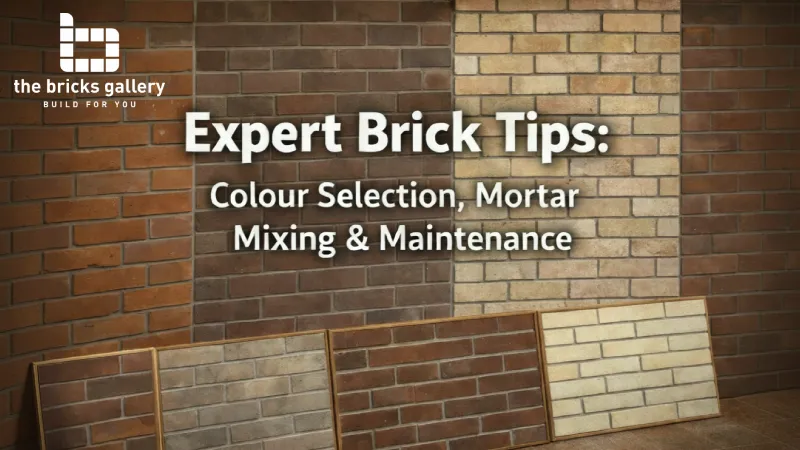
Expert Brick Tips: Colour Selection, Mortar Mixing & Maintenance
How to Choose the Right Brick
The right brick choice begins with understanding the demands of your specific project, not browsing for the most attractive finish. Consider your climate zone first — in high-humidity or monsoon-prone regions, water absorption is critical. Choose bricks with an absorption rate below 10% for exterior applications in these areas. In extreme heat zones, clay bricks with high thermal mass help regulate indoor temperatures naturally.
Match the brick type to its application: machine press cladding bricks are ideal for modern exterior facades where dimensional precision and clean lines matter. Handmould bricks suit heritage projects and farmhouse aesthetics where natural variation adds character. Vintage bricks and handmade cutting bricks are the go-to choices for exposed interior walls. Wire-cut bricks offer the best combination of structural strength and decorative texture for load-bearing exposed walls.
Brick Colour Selection Guide
Colour is the most visible quality of any brick installation and one of the hardest to correct after the fact. Never select a brick colour from a single sample or a photograph — both misrepresent how the brick will look at full wall scale and in your specific light conditions.
Always view samples in natural daylight at different times of the day. Morning and afternoon light change the perceived warmth of red and terracotta tones considerably. Request a panel of at least 10–15 bricks laid together to simulate the real wall appearance, including the natural colour variation within a batch.
As a general guide: Classic Red tones suit traditional and heritage buildings. Multi-tone blends add richness and character to both modern and traditional facades. Dark charcoal and graphite shades create a strong contemporary contrast. Yellow and buff tones work well with Mediterranean and coastal architecture. Antique and weathered finishes are the best choice for restoration and heritage-sensitive projects.
Consider the surrounding context — your roof colour, window frames, landscaping, and neighbouring buildings all influence which brick colour looks most cohesive in situ.
Mortar and Adhesive Guide
Mortar is as important as the brick itself — a poor mix or the wrong colour will undermine even the most premium brick selection. For standard structural brickwork, use a cement-to-sand ratio of 1:4. For cladding bricks on non-load-bearing surfaces, a polymer-modified ready-mix adhesive offers better flexibility and adhesion, particularly on existing wall substrates.
Mortar colour should complement the brick, not contrast with it. A joint that is too light or too dark draws the eye to the joint pattern rather than the brick texture. Most brick suppliers can recommend a mortar colour that matches their product range — always ask before mixing.
Prepare mortar in small batches that can be used within 30 minutes. In hot weather, this window shortens. Never re-temper stiffening mortar with additional water as it significantly reduces the final compressive strength of the joint.
Brick Quantity Calculation Formula
Underestimating quantities is one of the most common and costly mistakes in brick projects — sourcing additional bricks from a different production batch often results in a visible colour mismatch on the finished wall.
For standard bricks (230 x 110 x 75mm) with 10mm mortar joints, you will need approximately 48–50 bricks per square metre of wall. For brick slips and cladding bricks, this number varies by product format — check the specification sheet for your specific product.
Always add a minimum of 5% to your calculated quantity for wastage and cuts. For complex wall layouts with multiple openings, corners, or feature panels, increase this allowance to 10%. Contact our team for a precise project calculation — we provide this free of charge for all enquiries.
Climate Considerations for Brick Selection
India's diverse climate zones demand different brick specifications depending on project location. In the coastal and high-humidity zones of Kerala, Goa, and coastal Maharashtra, salt-laden air and monsoon moisture are the primary threats. Choose bricks with low water absorption (under 10%) and consider a masonry sealer for additional protection against salt crystallisation and efflorescence.
In the extreme heat belt of Rajasthan and central India, thermal mass is the critical property. Clay bricks absorb heat slowly during the day and release it at night, reducing cooling loads compared to lightweight construction materials. In seismic zones, specify bricks with high compressive strength and ensure all structural walls are built with proper reinforcement and mortar integrity.
Brick Maintenance Tips
Quality brick is fundamentally low-maintenance, but periodic care significantly extends both the appearance and structural integrity of the installation.
Annual cleaning: Wash brickwork annually with clean water and a mild detergent using a stiff natural-bristle brush. Work from top to bottom to avoid spreading dirt onto already-cleaned sections. Rinse thoroughly with clean water.
Avoid pressure washing: High-pressure water jets can erode mortar joints, particularly in older or handmade brickwork. If pressure washing is necessary, use the lowest effective pressure setting and keep the nozzle at least 300mm from the wall surface.
Mortar joint inspection: Inspect joints every 2–3 years. Tap the mortar with a small tool — a hollow sound indicates failure. Rake out failed joints to a depth of at least 20mm and repoint with fresh mortar. Delaying repointing allows water ingress that accelerates deterioration.
Sealing: In high-moisture areas, kitchens, bathrooms, or coastal locations, apply a clear penetrating masonry sealer every 5–7 years. This preserves the brick's natural appearance while significantly improving water resistance and resistance to efflorescence.
Conclusion
Every brick project — regardless of scale — benefits from the same disciplined approach: choose the right product for the conditions, select colour carefully with full-scale samples, mix mortar correctly, calculate quantities accurately, and maintain the installation periodically. These are not complex steps, but they are consistently the difference between brickwork that looks exceptional for decades and work that disappoints within years.
At The Bricks Gallery, our team is available to advise on all of the above at no cost. Request free samples or speak to our experts before your project begins.
FAQs
Brick Tips Colour Selection Mortar Mixing Brick Maintenance Brick Calculation Climate Guide Brick Care Masonry Sealer Brick Selection Expert Guide